
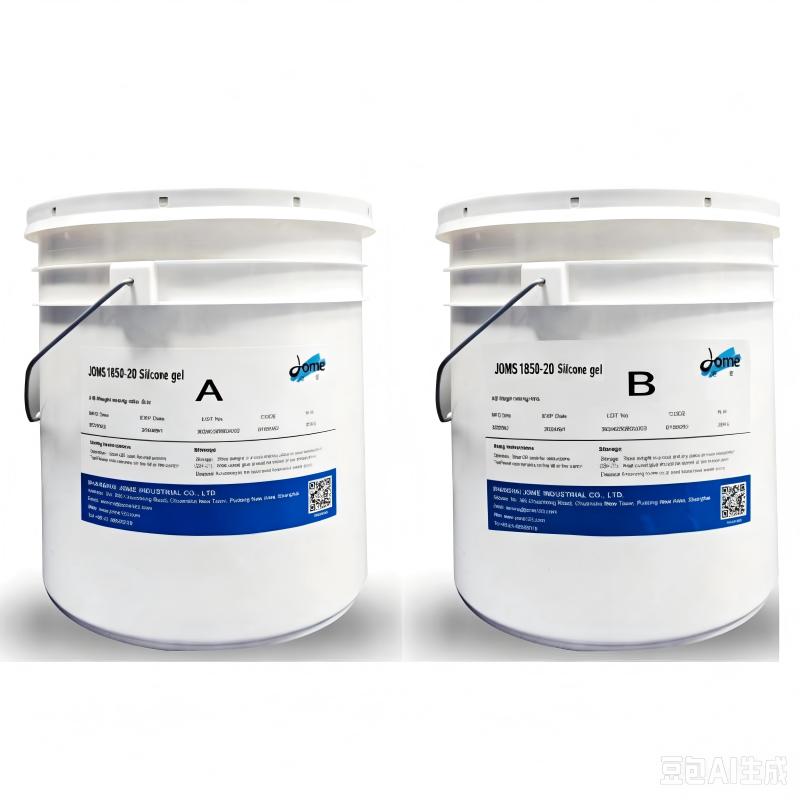
2-Part Thermal Conductive potting Silicone Gel (2.0W/mK)
JOMS1850-20A/B is a two-component silicone thermal conductive encapsulant that exhibits excellent fluidity after mixing; its application time can be adjusted according to temperature, and it cures deeply at room temperature. Its key characteristics include:
Dual-component addition-curing silicone rubber
1:1 Mixing Ratio
Low hardening shrinkage rate
Excellent high-temperature electrical insulation properties and stability
application area :
Automotive electronics & modules
LED Power Supply Drive Module
Solar module junction box
Electric Vehicle Charging Pole Module
Lithium-ion battery pack, Capacitor pack
Magnetic sensing coil inverter
Related products and applications
2-Part Thermal Conductive potting Silicone Gel (2.0W/mK) is listed in Potting & Encapsulating Compound. Explore related products and application reading below.
10:1 Condensation type high bonding strength silicone potting compound, General-purpose epoxy potting compound (black, white, red, clear), Vehicle-grade transparent self-healing encapsulated silicone gel.
product details
JOMS1850-20 Thermal Insulating Potting Silicone Gel Compound
Product Features and Application
JOMS1850-20A/B is a two-component silicone thermal conductive encapsulant that exhibits excellent fluidity after mixing; its application time can be adjusted according to temperature, and it cures deeply at room temperature. This product is suitable for the encapsulation and protection of various heat-dissipating, high-temperature-resistant components and fully complies with the EU RoHS Directive as well as the SVHC and REACH requirements. Its key characteristics include:
Dual-component addition-curing silicone rubber
1:1 Mixing Ratio
Low hardening shrinkage rate
Excellent high-temperature electrical insulation properties and stability
application area :
Automotive electronics & modules
LED Power Supply Drive Module
Solar module junction box
Electric Vehicle Charging Pole Module
Lithium-ion battery pack, Capacitor pack
Magnetic sensing coil inverter
Pre-sclerosis characteristics
| Test Item | Test Standard | Component A | Component B | ||
| Appearance Visual inspection Gray viscous liquid White viscous liquid | ||
| Viscosity (cps), 25°C | GB/T 10247-2008 | 6000±1000 5000±1000 |
| Specific gravity, g/cm³, 25°C | GB/T 15223-1994 | 2.65±0.05 2.65±0.05 |
| mixing ratio | mass ratio | A: B = 100: 100 |
| Mixed viscosity (cps), 25°C | GB/T 10247-2008 | 5000±1000 |
| Mixed operation time (minutes) | GB/T 10247-2008 | 30-50 |
| Initial curing time (hours) | GB/T 10247-2008 | 3-5 |
| Sclerosis conditions | GB/T 10247-2008 | 25°C/12 h or 70°C/60 min; 80°C/30 min |
| Post-curing properties | ||
| Sclerotic lesion appearance | visualization | Gray elastomer |
| Hardness: Shore 00 | GB/T 531-2008 | 30-60 |
| Thermal conductivity, W/mK | GB/T 10297-1998 | 2.0±0.1 |
| Tensile strength, MPa | GB/T 528-1998 | >0.3 |
| elongation,% | GB/T 528-1998 | >50 |
| Linear expansion coefficient, K⁻¹, ppm | HGT 2625-1994 | 150 |
| Dielectric strength, kV/mm | GB/T 1695-2005 | >15 |
| Volume resistance, DC 500 V, Ω·cm | GB/T 1692-92 | 1.2×10¹³ |
| Dissipation factor (1 MHz) | GB/T 1693-2007 | 0.01 |
| Dielectric constant (1 MHz) | GB/T 1693-2007 | 5.8 |
| Temperature range, °C | GBT 20028-2005 | – 60 ∽ 200 |
PS: The curing time and operating time were tested using a rubber mixing quantity of 100 g.
All data for the cured state were measured after the adhesive had been cured for 7 days under conditions of 25°C and 55% RH.
Operational Procedure
Before applying the adhesive, mix Components A and B thoroughly in their respective packaging; this is necessary because the fillers in the adhesive may partially settle during storage.
Weigh Groups A and B in a 1:1 ratio, mix them thoroughly, and then directly inject the mixture into the components (or modules) that require encapsulation protection.
matters need attention
Vacuum degassing of the mixed A/B components can enhance the performance of the hardened product.
For large quantities of A or B filler materials, ensure they are thoroughly mixed separately before weighing.
An excessively low temperature will result in a slower curing rate, while an excessively high temperature will lead to a faster curing rate; it is recommended to maintain a constant temperature in the workshop.
packing specifications
Pour the liquid slowly along one side of the container’s wall to minimize bubble formation.Allow the encapsulated components to stand still, allowing the bubbles to dissipate naturally; once the bubbles have largely disappeared, heat curing can be applied, or the components may be cured directly at room temperature – this process typically takes approximately 5–6 hours.For potting equipment requiring quantitative potting application, please contact our Company’s Marketing Department.
JOMS1850-20 may exhibit difficulty in hardening when in contact with materials containing sulfur, amines, organotin or unsaturated hydrocarbon plasticizers; common examples include rosin and natural rubber; therefore, a test should be conducted prior to use.
JOMS1850-20 High Thermal Conductivity Encapsulating Silicone; Order Codes: A 1850233, B 1850241
Component A: 2.5 kg per can, 15 kg per plastic drum
Component B: 2.5 kg per can, 15 kg per plastic drum
Storage and Transportation
This product should be stored in a cool, dry environment at a temperature not exceeding 35°C; the shelf life is 1 year when stored at a temperature below 25°C.
For Immediate Assistance, Please Contact us Now!
Contact Us
- 24-hour online service
- Own factory processing